October
28
,
2024
The Myth of Agency
Lessons from Carrie Oelberger: Part 2
Meaningful Work
,
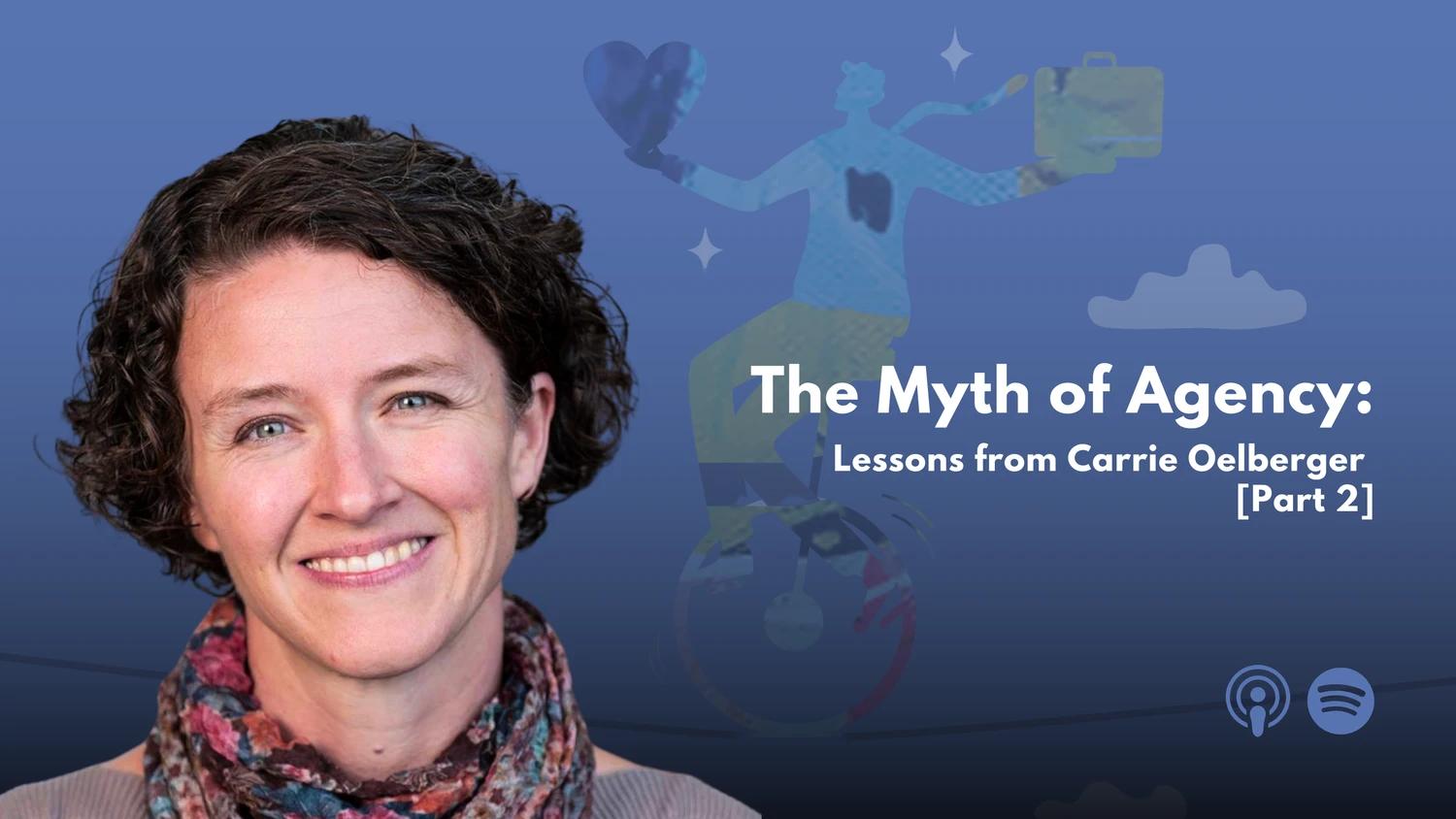
In part one of our conversation with Dr. Carrie Oelberger (above), we explored how meaningful work can become a double-edged sword, particularly when work devotion becomes "identity armor."
In part two, we dive deeper into another critical paradox: the myth of agency in meaningful work, and how it affects both workers and organizations.
Understanding the Myth of Agency
Oelberger introduces a powerful concept that challenges common assumptions about meaningful work: the myth of agency, which she defines as "the false cultural idea that an individual can fully overcome structural and institutional barriers through strategic individual behaviors."
This myth is particularly prevalent in caring professions and social impact work, where individuals often enter with high hopes of creating significant change, only to encounter systemic barriers that individual effort alone cannot overcome.
Three Approaches to Frontline Work
Through her research, Oelberger has identified three distinct approaches that workers take when facing structural challenges:
State Agents ("The Processors") | Citizen Agents ("The Fixers") | Human Accompaniment ("The Companions") | |
|---|---|---|---|
How They See Themselves | As bureaucrats | As advocates for clients | As partners with shared limits |
How They Work with Clients | Often blame clients for lack of progress | Strongly push for clients' needs | Build meaningful, compassionate relationships |
Longevity and Experience | Stay despite feeling burnt out or apathetic | Often leave quickly to make bigger changes | Stay long-term without burning out |
The Power of Human Accompaniment
Perhaps the most inspiring finding from Oelberger's research is the effectiveness of the human accompaniment approach. As she explains:
"These people don't burn out, they don't leave... When you ask these people how they feel about their work, they're like, 'I feel great about my work. I feel so lucky to be doing this. I'm so inspired by my clients.'"
Rethinking Selection and Training
Oelberger challenges traditional hiring practices, particularly the emphasis on formal education for roles where lived experience and emotional intelligence might be more valuable. She advocates for:
Identifying actual skills needed for positions
Looking beyond formal qualifications
Recognizing the value of lived experience
Being open to alternative forms of expertise
"I say this as somebody with a PhD who teaches masters and PhD students," Oelberger notes. "Sometimes we require qualifications for positions that not only don't require those qualifications, but in some ways, they can make you worse at doing your job."
Building Systemic Support for Meaningful Work
The conversation culminates in a discussion of how different countries approach work support systems. Oelberger shares an illuminating example of a European aid worker who received a year of parental leave with a replacement hire - a stark contrast to American expectations.
This points to a broader need for policy-level changes that can support meaningful work, including:
Universal healthcare access
Comprehensive parental leave policies
Education debt relief
Workplace protection policies
Social welfare benefits
As Oelberger puts it: "If society can build the boat, then we have more time to play with the sail."
Looking Forward…
This conversation with Dr. Oelberger highlights the need for a more nuanced understanding of meaningful work - one that acknowledges both individual agency and structural constraints. It suggests that creating truly sustainable meaningful work requires action at multiple levels:
Societal: Policy changes that provide basic security and support
Organizational: Rethinking hiring practices and work structure
Individual: Embracing approaches like human accompaniment that recognize both limitations and possibilities
The path forward isn't about trying harder within broken systems, but rather about reimagining how we support and structure meaningful work at every level.
Recommended Reading
Dr. Carrie Oleberger’s published work - link
Maslach, C., & Leiter, M. P. (2016). Understanding the burnout experience: recent research and its implications for psychiatry. World psychiatry : official journal of the World Psychiatric Association (WPA), 15(2), 103–111. https://doi.org/10.1002/wps.20311