15
,
2026
Called to Care?
Cindy L. Cain on Meaning, Mattering, and Healthcare's "Status Zoos"

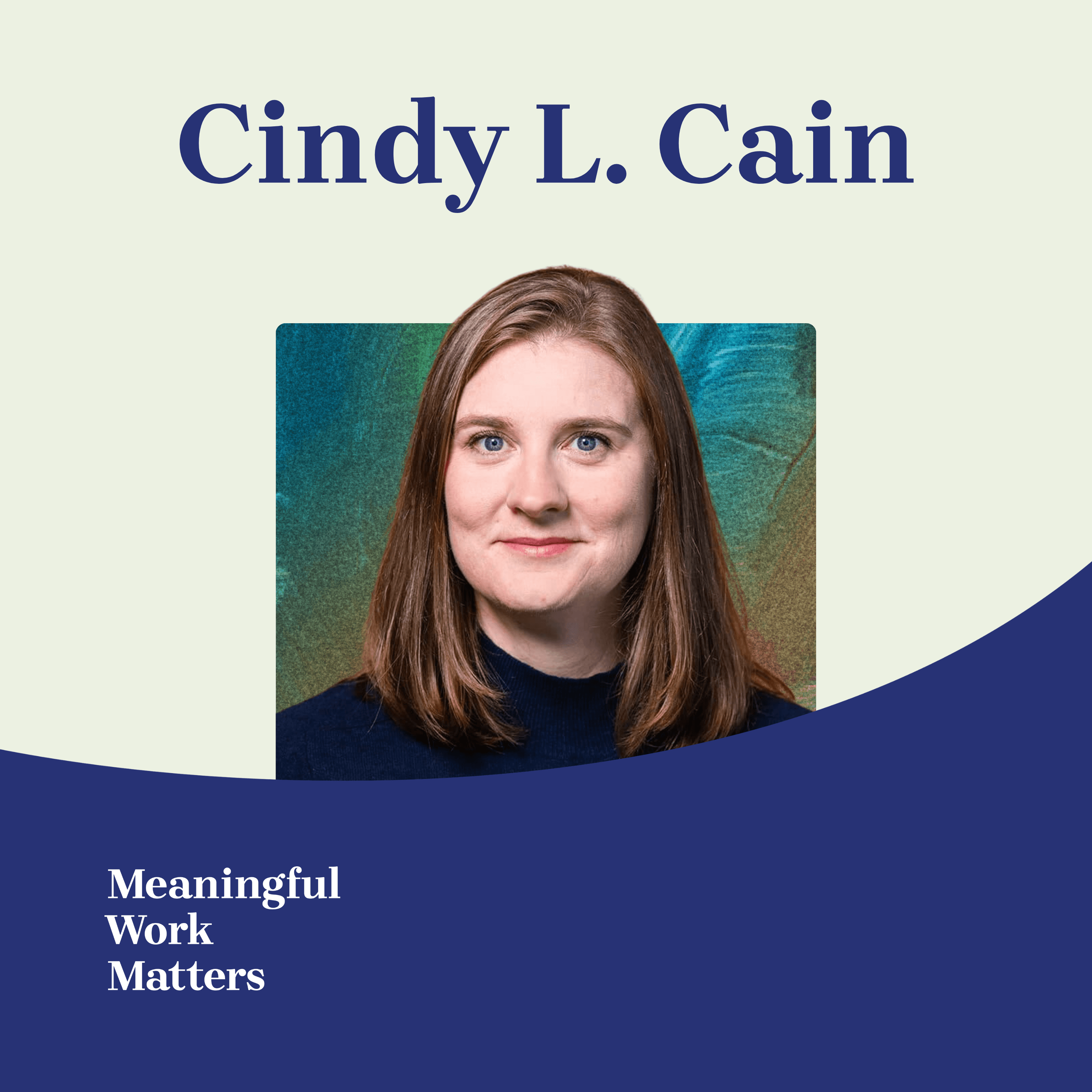
In this episode, Sociologist Cindy L. Cain joins Andrew Soren to discuss her new book, Called to Care? Health Care, Burnout, and the Search for Meaningful Work, based on fifteen years of research with healthcare workers.
Cindy challenges a familiar assumption about burnout: that meaning is something individuals must find, or recover, on their own. Her research argues that meaningfulness is created through the interaction between workers, their colleagues, and the structures and cultures surrounding their work. When those conditions make it difficult for people to see progress or act on what they care about, their sense of purpose begins to erode.
Andrew opens this episode the way you'd hope more conversations in this field started: by admitting he'd just read Cindy Cain's new book and couldn't believe they hadn't talked sooner. Cain's book, Called to Care? Health Care, Burnout, and the Search for Meaningful Work, is the product of fifteen years spent studying healthcare organizations, and its central argument is a genuinely useful reframe: burnout and meaningful work aren't two separate topics. They're the same topic, viewed from opposite ends.
Cain is an Associate Professor of Sociology at the University of Alabama at Birmingham, where she studies organizations and workplaces within healthcare. She's built her career looking at the settings where care work is hardest, like end-of-life care, dementia care, work with patients who have complex and overlapping needs. She also has direct experience as a care worker herself, including work with children, adults at the end of life, and people with developmental disabilities. That mix of scholarly distance and lived proximity to the work runs through the whole conversation.
The Missing Piece in Burnout Research
The standard definition of burnout has three components: emotional exhaustion, depersonalization, and a loss of sense of purpose or efficacy — the feeling that your work doesn't matter. Cain's core argument starts with a specific, almost technical observation: that third component kept getting quietly dropped from research. In study after study, it didn't move the needle in statistical models the way the other two did, so some researchers stopped measuring it at all.
To Cain, that was exactly backwards. The sense that your work matters isn't a weak variable to discard. It's the center of the problem. Her book's whole project follows from taking that seriously: instead of asking people what exhausts them, she started asking when they felt like they'd done good work, and what got in the way of that. The answers pointed where research on burnout hadn't spent much time looking: not at individual coping, but at the structures of the job itself.
If the missing ingredient is structural, the fix has to be too. Cain is candid about how absent this is from most workplace responses to burnout. Organizations tend to reach for individual-level interventions like coping skills, meditation, resilience training, which can genuinely help, but which leave the underlying structural problems untouched.
Cain draws a useful distinction between an organization (the local workplace, its leaders, its defined roles) and an institution (the larger regulatory and professional structure sitting above it). The institution is usually where the deep meaning of caregiving comes from. It’s the sense that helping another person matters. But it's the organization, sitting between that institutional meaning and the individual worker, where obstacles tend to pile up. Rebuilding an institution is close to impossible on any realistic timeline. Removing organizational obstacles is not. Cain positions her whole book at that middle, tractable level, deliberately.
One of her former advisors used to describe healthcare organizations as "status zoos," places where professional status, organizational status, and social status (race, gender, citizenship, language, culture) all collide and stack. It's a reminder that the system isn't neutral: those layers shape who has access to meaningful work and who doesn't, long before an individual's resilience or coping skills ever enter the picture.
Progress as a Locus of Control
A locus of control refers to the ring of things a person can actually influence, as distinct from everything happening around them that they can't. Cain's research maps that ring explicitly. An executive has a wide, officially sanctioned ring of control over an organization. A certified nursing assistant has almost none of that. No control over hours, staffing, or compensation. But a nursing assistant often has real, meaningful control over what happens inside a specific care encounter: how much time to take, how much patience to bring, how to handle a moment of resistance or confusion.
Progress is what that control looks like in practice. In the settings Cain studies, patients often aren't going to get better. Advanced dementia doesn't reverse. But workers still find ways to create forward motion inside that reality: getting shoes onto a resident who's resisting, at the resident's pace rather than rushing it; letting a conversation follow wherever a confused resident takes it instead of correcting them, a technique Cain calls conversational scaffolding. None of it changes the diagnosis. All of it is progress, and all of it sits squarely inside the small ring of control a worker actually has. Cain's point isn't just that progress feels good. Creativity researcher Teresa Amabile has already shown that visible forward motion disproportionately supports well-being. Cain's point is more specific: progress is often the only lever left once the bigger ones are out of reach, which makes it worth treating as a resource to protect, not a nice-to-have.
Memory Care Facilities
Cain's central case study is a memory care facility she calls Care North. In other parts of her research, workers repeatedly told her that meaning became hardest to sustain specifically in dementia care, where patients often can't reciprocate connection or communicate in familiar ways. Cain, who has had family members with dementia, wanted to know whether workers dedicated entirely to that population built meaning differently.
What she found was a genuine outlier: good staffing, low turnover (one nursing assistant had been there almost twenty years), and a head nurse who spent real time on the floor and delegated discretion downward instead of hoarding it. Cain calls it one of the best research experiences of her career.
One ritual captures the place best. From mid-October through Christmas, a nursing assistant organized residents into a carolling group, teaching simple songs and basic choreography. Many residents couldn't reliably recall the words, but music tends to stick with dementia patients longer than facts do, and enough of it came back. The group eventually toured other wings of the facility, singing to residents who weren't part of it. Cain calls rituals like this microcultures: the specific, local habits that structure daily life while still reflecting the larger institutional forces above them. She's deliberately skeptical of "culture" as a scholarly concept, because it's grown broad enough to explain everything and nothing. A microculture is small enough to actually point at, and small enough to actually change.
The Pivotal Role of the Middle Manager
In Cain's framework, mid-level leaders matter more than almost anyone else in the system. She's candid about how hard this is to sell upward. She describes a recent conversation with a quality leader who dismissed her entire framework with a shrug: some people are just jerks, he told her, and that's the whole problem. Cain doesn't read this as unusual callousness. Leaders are busy, stretched across competing priorities, and a well-being initiative rarely comes with the time or resources to do it properly. Falling back on a convenient, individual-level explanation is often just easier than confronting a structural one.
But senior leaders, for all their official authority, often have less real influence over daily experience than the people just below them. Mid-level leaders retain a direct connection to what's actually happening on the ground, something senior leadership frequently loses. They may not control the institution. They rarely control the whole organization. But they have outsized control over the microcultures that Cain's research keeps circling back to as the actual site of change.
Where to Start
Cain doesn't offer a formal program for any of this, and her book is intentionally light on prescriptions as she's more interested in giving leaders a better diagnostic lens than a checklist. A few concrete moves surface across the conversation anyway, worth carrying into an actual team.
Start by asking where your team's locus of control actually sits. People often assume their sense of purpose depends on things far outside their reach, like outcomes, staffing levels, organizational strategy. Cain's research points to the smaller ring instead: what can this person actually influence today, and is there enough room in their role to use it?
Protect the small rituals already working before reaching for a new initiative. Care North's carolling group wasn't designed by leadership, it was something a nursing assistant built because she had the autonomy to. The more useful move is often noticing what's already working at that scale and getting out of its way, rather than replacing it with something official.
And if you manage people without sitting at the top of the org chart, take Cain's argument as a direct address: your daily decisions about how much discretion to hand your team aren't a smaller version of real leadership. In her research, they're often the whole thing.
Meaning, Constructed Together
Near the end of the conversation, Andrew reads back a line from the book that he calls its clearest summary: meaningfulness is neither something in the heads of workers nor an immutable property of the job. Instead, it emerges from how workers, individually and collectively, interact with and within the structures of work.
Cain's own gloss on that line ties every thread of this episode together. Meaning isn't purely personal, tucked away in an individual's head, too precious to intervene on. It isn't a fixed property some jobs have and others simply lack, either. In her research, she's never found a job she'd call entirely meaningless, not even her go-to hard case, an elevator attendant, whose role turns out to matter through the relationships and sense of security it provides. Seeking meaning, she argues, is close to a universal human drive, and work is one of its major outlets for most people. Treat meaning as something built from the tools, structures, and culture available in a given workplace, rather than as a trait a job either has or lacks, and it becomes something leaders can actually construct more of.
Andrew closes with his own reflection: he wishes more leaders, at every level and with or without formal authority, understood the role they already play in shaping the microcultures around them. The power to change things for the people they work with has been sitting there the whole time.
Mentioned in This Episode
Called to Care? Health Care, Burnout, and the Search for Meaningful Work by Cindy L. Cain
Julie Haizlip, University of Virginia, and her research on "mattering" in healthcare
Teresa Amabile's research on the progress principle
Cindy Cain's Substack, featuring personal essays connecting these themes to her own work and creative life
Additional academic articles by Cindy Cain